
What Would Your SaaS Say If It Could Talk? Why Founders Need Translation, Not More Dashboards
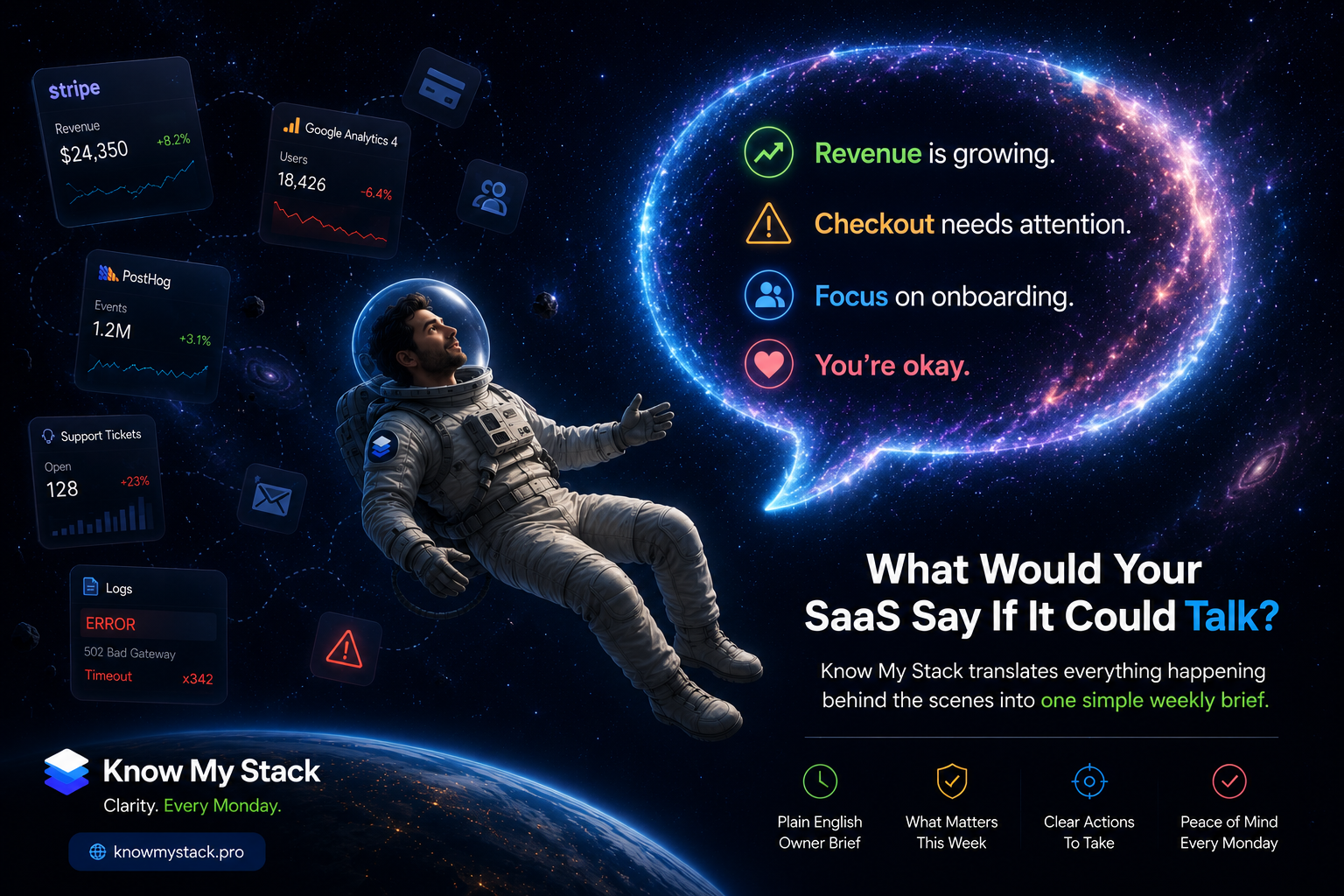
What Would Your SaaS Say If It Could Talk?
Why Founders Need Translation, Not More Dashboards
What Would Your SaaS Say If It Could Talk? Why Founders Need Translation, Not More Dashboards
If you're a non-technical SaaS founder, you've probably experienced this before.
You open Stripe.
Then GA4.
Then PostHog.
Then your support inbox.
Then Slack.
Then your project management tool.
Thirty minutes later, you've looked at plenty of data but still can't answer a simple question:
How is my business actually doing?
This is the hidden problem most founders face.
It's not a lack of information.
It's a lack of understanding.
The Problem Isn't Data. It's Translation.
Modern SaaS businesses generate more information than ever.
Revenue data.
User behaviour.
Traffic sources.
Conversion rates.
Support tickets.
Error logs.
Infrastructure alerts.
Developer updates.
The average founder is surrounded by information but often starved of clarity.
Most tools were designed for specialists.
Developers understand error logs.
Marketers understand analytics.
Product teams understand user journeys.
But founders need something different.
Founders need answers.
SaaS Dashboard Overload Is Real
Many founders assume they need more dashboards.
More reports.
More notifications.
More integrations.
The reality is often the opposite.
Every new dashboard adds another place to check.
Another set of metrics to interpret.
Another source of anxiety.
You end up spending more time looking at your business than understanding it.
The result?
Decision fatigue.
Uncertainty.
And a constant feeling that something important might be slipping through the cracks.
Imagine If Your SaaS Could Talk
Let's imagine something different.
Imagine your business could send you one honest message every Monday morning.
Not a spreadsheet.
Not a chart.
Not a technical report.
Just a simple conversation.
It might say:
"Revenue is growing steadily."
"Your onboarding process is losing new users."
"Three customers experienced the same issue this week."
"Your latest content is bringing in qualified traffic."
"Nothing urgent needs attention."
"You are okay."
Now think about that for a moment.
Would that be more useful than opening six different dashboards?
For most founders, the answer is obvious.
What Non-Technical SaaS Founders Actually Need
Most non-technical SaaS founders don't want to become analysts.
They don't want to spend their mornings decoding metrics.
They don't want to chase developers for updates.
They don't want to wonder whether an issue is serious or not.
What they want is clarity.
They want to know:
- What happened this week?
- What needs attention?
- What should I focus on next?
- What opportunities am I missing?
- Is the business healthy?
These are business questions.
Not technical questions.
Why SaaS Founder Reporting Needs To Change
Traditional SaaS reporting often assumes more information equals better decisions.
But information without context creates confusion.
Good reporting should answer questions, not create more of them.
Instead of showing founders hundreds of data points, reporting should highlight:
What Happened
The important changes that occurred during the week.
What Needs Attention
The issues that could affect growth, revenue or customer experience.
What To Do Next
Practical actions that move the business forward.
Opportunities
Areas where simple improvements could generate results.
This is where true business clarity comes from.
SaaS Analytics Explained In Plain English
Analytics tools are incredibly powerful.
But many founders don't need direct access to every metric every day.
What they need is interpretation.
For example:
Instead of:
"Activation rate decreased from 42% to 36%."
A founder-friendly explanation might be:
"Fewer trial users are reaching the point where they experience value. Reviewing onboarding could increase conversions."
Same data.
Completely different outcome.
One creates confusion.
The other creates action.
The Weekly SaaS Report Founders Actually Want
A useful weekly SaaS report should feel less like analytics software and more like a trusted advisor.
It should tell you:
- What is working.
- What is broken.
- What has changed.
- What deserves your attention.
- What can wait.
Most importantly, it should help you make decisions quickly.
Because founders don't need more complexity.
They need confidence.
The Rise Of The SaaS Owner Brief
The future isn't another dashboard.
The future is translation.
A simple SaaS Owner Brief that brings together information from across your business and explains it in plain English.
No more guessing.
No more jumping between tools.
No more wondering what to ask your developer.
Just a clear understanding of what's happening behind the scenes.
Final Thoughts
If your SaaS could talk, what would it say?
Would it tell you revenue is growing?
Would it warn you about onboarding problems?
Would it highlight opportunities you're missing?
Or would it simply reassure you that everything is moving in the right direction?
The most valuable founders aren't the ones who stare at dashboards all day.
They're the ones who understand what matters and act on it.
And that starts with clarity.
Not more data.
Not more tools.
Not more dashboards.
Just understanding.
